"It's all that's left of one of the greatest men who ever lived; he founded the only faith that never became stained with blood. I'm sure he would have been most amused to know that, forty centuries after his death, one of his teeth would be carried to the stars"
- Arthur C Clarke in The Songs of Distant Earth (p211).
My favorite author writing about my favorite human. Can I call it a tribute ? Surely, for those who know, his teeth will not be the only thing left thousands of years from now.
In a previous novel, The Fountains of Paradise, Clarke explores the space elevator in detail. For some reason, he includes jealous and superstitious Buddhist monks in his setting. Clarke likes to quote "All things are impermanent" hinting at the Buddha. Yet, he makes a joke of religion, God and even the Buddhists by making them abandon a several thousand year old Buddhist site due to some superstition.
Perhaps, Clarke's understanding of Buddhism has improved since that novel. Spaceship Magellan escapes just in time, when the Earth's sun goes nova. They "trash" various ancient texts and books. However, the Chief Tech person carries a tooth of the Buddha along with him, gifting it to a lady on Thalassa some 50 light years away.
Clarke may be a great science fiction writer, but I disagree about criticising and dismissing things we don't know about. But still he is "light years" more knowledgeable than one Ayn Rand.
Having said that, let me add that a quarter century after first reading his works, I have been spending some precious spare time reading them again. They are still great works. His mind is one of the finest and most imaginative. And many thanks, Mr. Clarke, for adding Beethoven's and Bach's works in what was carried to the stars by the seedship, even if you trashed the Vedas. It feels good to know that in some future life, on some strange planet, I will still be able to hear my favorite composers. But what did you have against Beethoven's Fourth ? Disk space will be very cheap in the future, is my prediction :-)
The Eternal Light

"Know and always hold onto the Self.
Disregard the body and the mind.
To identify with them is misery.
Dive deep into the Heart,
the source of being and peace,
and establish yourself there."
Disregard the body and the mind.
To identify with them is misery.
Dive deep into the Heart,
the source of being and peace,
and establish yourself there."
Father

Bhagavan is the awareness
Why despair ? Know with certainty by enquiry, that I myself am present as your "I".
-- Father
-- Father
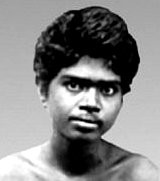
My Bhagavan
Believe nothing because a wise man said it;
Believe nothing because it is generally held;
Believe nothing because it is written;
Believe nothing because it is said to be divine;
Believe nothing because somebody else believes it;
Believe only what you yourself judge to be true
- Gautam Buddha